A new study from the laboratory of Gemma Carvill, PhD, associate professor in the Ken and Ruth Davee Department of Neurology’s Division of Epilepsy and Clinical Neurophysiology, has uncovered variants in noncoding regulatory regions of the genome that contribute to the development of neurodevelopmental disorders.
The findings, published in Nature Communications, could help spearhead the development of more effective precision therapeutic strategies for patients.
“We now know that most neurodevelopmental disorders have a genetic component. For those individuals with unexplained causes, we think that many are likely due to these noncoding variants. These noncoding variants can disrupt the function of cis-regulatory elements, but cis-regulatory elements are also good targets for precision therapeutics,” said Carvill, who is also an associate professor of Pharmacology and of Pediatrics.
Neurodevelopmental disorders are a range of developmental disorders that impair brain and nervous system function throughout a person’s lifespan and most often begin in childhood. The disorders include intellectual disabilities, autism spectrum disorder, attention-deficit/hyperactivity disorder (ADHD) and epilepsy, among others.
While patients are often prescribed multiple antiseizure medications and neuropsychiatric therapies to help treat symptoms, they are not always effective and fail to target the root cause of the disorder, according to Carvill.
“What we do right now in clinical care is treat the symptoms of the disorder; we’re not treating the root cause. That’s really the goal of our research: to find the genetic cause for these individuals’ disorder and rather than treating the downstream manifestations, target the gene and fix the actual root cause of the condition,” Carvill said.
Nearly 17 percent of all neurodevelopmental disorders are caused by pathogenic structural variants — genomic variants that have differences in at least 50 nucleotides in a segment of DNA — that disrupt coding regions, the portion of the DNA that codes for proteins.
Genes that code for proteins only make up about 1 percent of the entire genome, leaving the remaining 99 percent of non-protein-coding DNA open for further investigation, Carvill said.
In the current study, Carvill’s team aimed to determine how structural variants in one noncoding region of the genome may drive pathogenesis in individuals with neurodevelopmental disorders.
First, the scientists used the DECIPHER (DatabasE of GenomiC VarIation and Phenotype in Humans using Ensembl Resources) database to identify 14q12 microdeletions downstream of the neurodevelopmental disorder-related gene, FOXG1, in individuals with epilepsy and related neurodevelopmental disorders.
“That gene [FOXG1] is known to be involved in neurodevelopmental disorders and causes a very similar clinical phenotype when you have pathogenic variants in the gene. We thought perhaps there are some regulatory elements in this region that, if deleted, would reduce the amount of FOXG1 in much of the same way a coding variant would,” Carvill said.
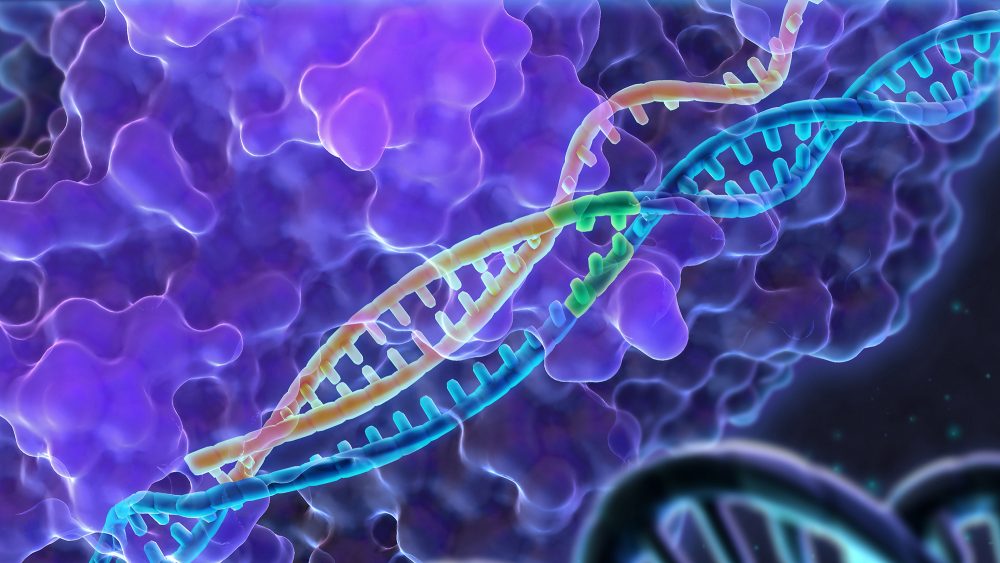
Using CRISPR-Cas9 gene editing, the scientists then created 14q12 microdeletions in HAP1 human cell lines with FOXG1 expression. These deletions, downstream of FOXG1, caused a decrease in FOXG1 protein, which is also observed in neurodevelopmental disorder patients with FOXG1 coding variants.
Next, the scientists used a chromatin conformation capture technique to identify the mechanisms driving reduced FOXG1. In regions with 14q12 microdeletions, they discovered several cis-regulatory elements — those regions of noncoding DNA that regulate the transcription of neighboring genes — promoting FOXG1 expression.
The findings demonstrate how noncoding regions of the genome can cause neurodevelopmental disorders, Carvill said, and should prompt further investigation into the effects of structural variants in other noncoding regions across the genome, which can help inform new gene-targeting therapies for patients.
“The locus is actually very challenging, and what I mean by that is we deleted a small segment, but it turns out that this whole region actually contains a lot of different cis-regulatory elements that probably act at different times in neurodevelopment, probably to switch the gene downstream on in different cell types and different times in development, and so we’re interested in doing a deep mechanistic dissection of this entire region. We can use this information to precisely target these cis-regulatory elements and restore FOXG1 expression in individuals with this condition,” Carvill said.
Aishwarya Ramamurthy, ‘25 PhD, a former student in the Driskill Graduate Program in Life Sciences (DGP), was lead author of the study.
Co-authors of the study include Esther Yoon and Nicholas Bodkin, MSTP students; and Jeffrey Calhoun, PhD, research assistant professor in the Ken and Ruth Davee Department of Neurology’s Division of Epilepsy and Clinical Neurophysiology.
This work was supported by the Chicago Biomedical Consortium Catalyst Award and the American Epilepsy Society Predoctoral Fellowship.