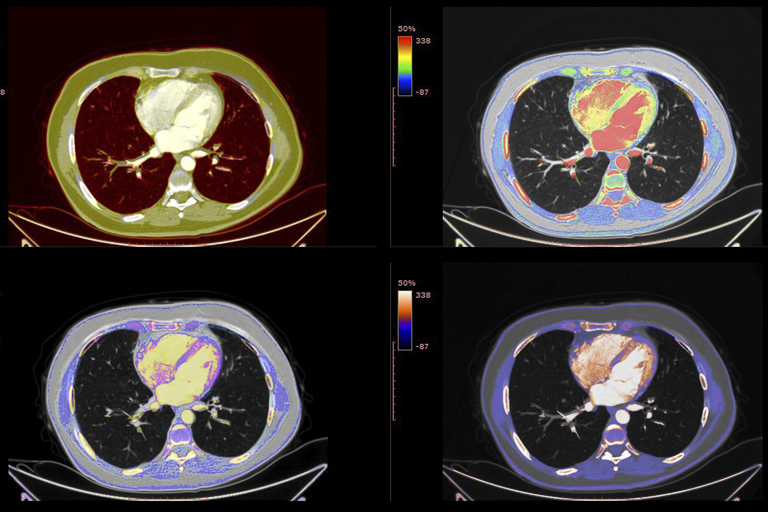
A PET/CT radiotracer demonstrated high sensitivity and specificity for diagnosing cardiac amyloidosis, a rare disease that causes abnormal protein buildup in the heart and heart failure, according to a recent clinical trial published in JAMA.
The findings suggest using the radiotracer, iodine-124-evuzamitide, in clinical workflows could provide diagnostic clarity for patients when standard imaging tests do not firmly establish or rule out a diagnosis.
“If there’s a high suspicion, but the current standard-of-care imaging was equivocal, this could be an amazing addition to our diagnostic armamentarium. If I-124 evuzamitide imaging were positive, it would give the patient the diagnosis,” said Richard L. Weinberg, MD, PhD, associate professor of Medicine in the Division of Cardiology and a co-author of the study.
Systemic amyloidosis is a rare disease which occurs when abnormal proteins form amyloid fibrils and deposit in organs and tissues throughout the body, which can ultimately lead to the dysfunction of a variety of organs, including the heart.
The two most common forms of systemic amyloidosis are transthyretin amyloidosis (ATTR)and immunoglobulin light chain amyloidosis (AL). ATTR occurs when either the naturally occurring or a abnormal form of transthyretin protein misfolds and forms amyloid fibrils. In contrast, light chain amyloidosis occurs when abnormal plasma cells produce misfolded proteins.
Systemic amyloidosis can also impact the heart: the abnormal buildup of amyloid causes the walls in the heart muscle to thicken, making the heart work harder to pump blood throughout the body and cand lead to heart failure and arrhythmias.
Diagnosing cardiac amyloidosis is difficult, however, as outside of a heart biopsy, no single test can definitively confirm or exclude a patient’s diagnosis, Weinberg said.
“From the heart perspective, we use a combination of imaging studies such as nuclear medicine cardiac amyloid scans, echocardiography, and cardiac MRI, in addition to blood tests and serologies to diagnose cardiac amyloid. Depending on the type of amyloid, we need to check to see what type of abnormal proteins are in the blood, if there are any,” Weinberg said.
In the current phase III clinical trial, the scientists aimed to evaluate the sensitivity and specificity of a new radiolabeled synthetic peptide iodine-124-evuzamitide used in PET/CT imaging for diagnosing cardiac amyloidosis.
Evuzamitide works by directly binding to amyloid fibrils in patients with cardiac amyloidosis, with previous work demonstrating that it can effectively image ATTR, light chain amyloidosis and other types of cardiac and systemic amyloidosis.
In the clinical trial, a total of 170 patients suspected to have cardiac amyloidosis from 18 medical centers across the U.S., including Northwestern Memorial Hospital, were enrolled.
PET/CT scans were completed three to five hours after one dose of evuzamitide was intravenously administered to patients. Potassium iodide was also given orally (130 milligrams) for three days starting 30 minutes prior to the evuzamitide injection.
Overall, the investigators found evuzamitide performed with high sensitivity (94 percent) and specificity (86 percent) in diagnosing cardiac amyloidosis in patients with both ATTR and immunoglobulin light chain amyloidosis.
“The basic science showed that evuzamitide binds very tightly and specifically to amyloid fibrils, so the thought was, and with the preclinical data, that it should be very sensitive and very specific for amyloid. It was very nice to see that it played out well among all participants, and the tracer performed quite comparably in patients with light chain and transthyretin cardiac amyloid,” Weinberg said.
The results, according to Weinberg, can support the approval of evuzamitide for clinical use, with further research needed to best determine how to integrate evuzamitide into diagnostic workflows.
“If patients have a confirmed diagnosis based on current standard of care, is this really necessary or will this become standard of care?” Weinberg said. “The patients where this would be very applicable in my clinical workflow or in our amyloid group’s clinical workflow, for example, are those who had equivocal clinical diagnoses, where we’re not 100 percent sure.”
This work was supported by Bayer.