Tag: podcast
-

Partnering with Libraries to Address Teen Mental Health with Ashley Knapp, PhD and Robert Simmons, MA
Teens are reporting struggles with their mental health at unprecedented rates, but resources to help these young people deal with anxiety or depression can be difficult to access. An innovative community partnership between Northwestern Medicine investigators and a Chicagoland library is laying the groundwork to bring digital mental health resources to historically underrepresented teens living…
-
Pursuing Deeper Understanding of Inflammation with Murali Prakriya, PhD
Inflammation is a common feature of many diseases and Northwestern Medicine investigators have identified how a calcium channel contributes to inflammation in the brain and lungs. This could aid in finding new types of therapeutics for inflammation-related diseases and conditions. In this episode, Murali Prakriya, PhD, discusses the evolution of this groundbreaking research in ion…
-

Medical Research Funding at Risk with Rod Passman, MD
A Northwestern Medicine clinical trial led by Rod Passman, MD, could improve the way we care for millions of people with atrial fibrillation, but it is facing an unexpected challenge. There has been a pause in federal funding to Northwestern University that could impact this study’s progress. While the trial has not been ordered to…
-
Improving Cardiac Health Through Immune System Precision with Edward Thorp, PhD
Each year, more than 800,000 Americans suffer a heart attack and many of those who survive are left with irreversible scarring and the slow progression towards heart failure. In this episode, Edward Thorp, PhD, explains how his team is exploring immune cells that influence the heart’s ability to heal after such injuries. In Thorp’s lab,…
-
A Promising Drug for Alzheimer’s Disease with William Klein, PhD, and Richard Silverman, PhD
An experimental drug called NU-9 was invented at Northwestern University by Richard Silverman, PhD. It has been approved for clinical trials for the treatment of ALS and found to improves neuron health in animal models of Alzheimer’s disease according to a new Northwestern Medicine study published in the Proceedings of the National Academy of Sciences.…
-
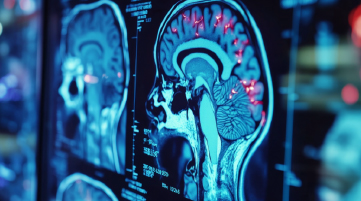
New Insights from Inside the Brain with Rodrigo Braga, PhD
In this episode, Rodrigo Braga, PhD, explains recent advances in his Human Cognitive Neuroscience Lab, using precision functional MRI technology, that is helping us better understand how the brain is working. He details recent findings published in Science Advances that provide new understanding of how the brain works during and after social interactions, which could…
-

Can a Single Session Impact Mental Health for Teens? with Jessica Schleider, PhD
New evidence shows that a one-time intervention can lead to lasting improvement in the lives of young people struggling with mental health problems. In this episode, Jessica Schleider, PhD, associate professor of Medical Social Sciences, explains how she is using this approach to scale single-session interventions (SSIs) to reach more people in need of mental…
-

The Science Behind Sleep Health with Minjee Kim, MD
In this episode, Minjee Kim, MD, shares results of recent studies she has conducted to better understand the role of inadequate sleep on long-term metabolic health in pregnant women and middle-aged adults. She also discusses a new AI-based intervention that could bring a better night of sleep to those who need it.
-

Intervening Earlier in Mental Healthcare for Kids with Lauren Wakschlag, PhD
A new $11.7 million award from the National Institute of Mental Health aims to help Northwestern Medicine investigators move the dial on the youth mental health crisis by targeting early warning signs of mental health risk in toddlers, rather than waiting until diagnosable and severe conditions are present later in childhood. In this episode, Lauren…
-
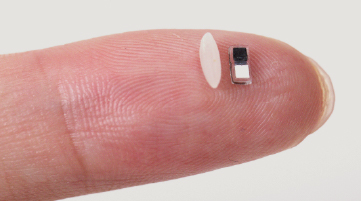
Inventing a Tiny Pacemaker with John Rogers, PhD
What could be the world’s smallest pacemaker was recently developed at Northwestern University and details of the device were published in the journal Nature. This incredible innovation, about the size of a grain of rice, from the lab of John Rogers, PhD, is designed to be an alternative to bulky, wired temporary pacemakers. In this…