Media Coverage
The work done by Northwestern University Feinberg School of Medicine faculty members (and even some students) is regularly highlighted in newspapers, online media outlets and more. Below you’ll find links to articles and videos of Feinberg in the news.
-
Chicago Tribune
–
Northwestern Medicine research finding opens the door to a viral link to Parkinson’s disease
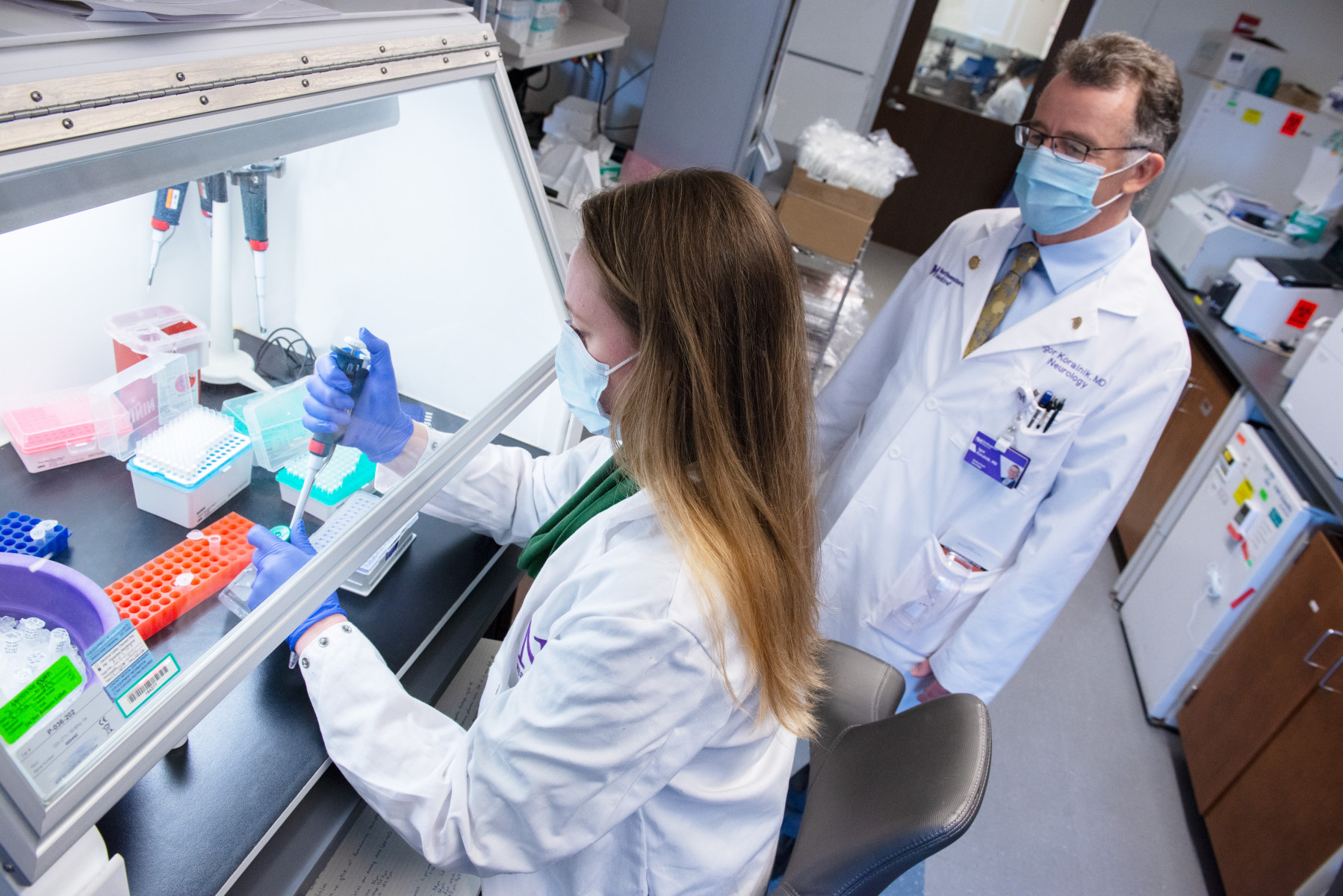
A Northwestern Medicine research lab has found a usually harmless virus in brain samples from Parkinson’s patients. The idea that Parkinson’s could be linked to a virus had been theorized for years, but this is the first study to pinpoint a specific virus as more common in Parkinson’s patients. “The message that we want to give to the general public is, it opens a new field of investigation, something that we didn’t know about,” said Igor Koralnik, MD, Northwestern’s chief of neuroinfectious diseases and global neurology and lead author of the study. Before this study, Hanson said, HPgV had not been found in human brain tissue. It was understood to primarily “live” in blood. “For this virus to be present in the brain, there must be a reason for that,” Koralnik said. It’s possible that this is why Parkinson’s risk increases with age, Bega said. The longer you live, the more of these “hits” you take, as you encounter different Parkinson’s risk factors throughout your life. “I always caution people who try to blame their Parkinson’s on one thing,” he said. “Rest assured, it’s never one thing that you could have done or should have done differently.”
-
Huffington Post
–
Here’s What You Should Do If There’s A Measles Case In Your Area
The measles outbreak in West Texas and beyond is only getting worse. Two unvaccinated children have died of the virus, and measles cases are the highest they’ve been in 33 years. It’s natural to be scared of this highly contagious virus, which in rare cases can cause death and severe illness, but not everyone has to have the same level of worry. (Yes, vaccination is key for your safety.) If you aren’t sure of your vaccine history, you have a few choices. It’s a scary time to not be sure if you’re fully vaccinated against measles, but there are a couple of things you can do, according to Michael Angarone, DO, an associate professor of medicine in the division of infectious diseases at Northwestern Medicine in Chicago. First, you can ask your doctor to run a blood test to see if you have antibodies to measles, he said. If you do have antibodies, that means you’re protected. If you don’t, you can set up an appointment for your shot.If you can’t get the blood test, “The other option is to just get vaccinated. There is not harm in getting an extra dose of the MMR vaccine as an adult,” Angarone noted.
-
HealthDay
–
A Usually “Harmless Virus” May Trigger or Contribute to Parkinson’s Disease
A usually harmless virus might be an environmental trigger or contributor to Parkinson’s disease, a new study suggests. Researchers at Northwestern Medicine developed a tool called ‘ViroFind,’ which detects 565 viruses known to infect humans in a single assay or test. They analyzed post-mortem brain samples from 10 people with Parkinson’s disease and 14 control subjects who died from other causes. “Using this assay, we found a specific virus called the human pegivirus, which is otherwise not known to cause disease, to be present in half of the patients’ brains who had Parkinson’s disease compared to none of those control brain patients.” Igor Koralnik, MD, lead author of the study, says the infected brains exhibited more advanced disease, including increased tau pathology and altered levels of certain brain proteins. Koralnik stresses this is an exploratory study. “It doesn’t mean that those viruses cause the disease, but it suggests that they may be implicated on how the immune system reacts to those viruses that may be associated with the Parkinson’s disease.” Parkinson’s disease affects more than one million people in the United States.
-
US News & World Report
–
‘Harmless’ Virus Might Trigger Parkinson’s Disease, Researchers Say
A common virus once thought harmless to humans might be linked to Parkinson’s disease, a new study says. The germ, Human Pegivirus (HPgV), was found in half the autopsied brains of patients with Parkinson’s, but not in any brains from healthy people, researchers reported July 8 in the journal JCI Insight. “HPgV is a common, symptomless infection previously not known to frequently infect the brain,” lead researcher Igor Koralnik, MD, chief of neuroinfectious diseases and global neurology at Northwestern Medicine in Chicago, said in a news release. “We were surprised to find it in the brains of Parkinson’s patients at such high frequency and not in the controls.” The virus also appeared to prompt different responses from people’s immune systems, depending on their genetics, Koralnik said. “This suggests it could be an environmental factor that interacts with the body in ways we didn’t realize before,” Koralnik said. “For a virus that was thought to be harmless, these findings suggest it may have important effects, in the context of Parkinson’s disease. It may influence how Parkinson’s develops, especially in people with certain genetic backgrounds.”
-
Fox News
–
Never smoked? You could still be at risk of developing lung cancer, doctors warn
Lung cancer, the second-most common cancer in the U.S., is often associated with smoking — but even those who have never had a cigarette could be at risk of the deadly disease. While it’s true that those who smoke face a much higher risk, up to 20% of lung cancers affect people who have never smoked or have smoked fewer than 100 cigarettes in their lifetime, according to the U.S. Centers for Disease Control and Prevention (CDC). Mohamed Abazeed, MD, PhD, chair of radiation oncology and the William N. Brand Professor at the Northwestern University Feinberg School of Medicine in Chicago, agrees that the share of lung cancers diagnosed in never-smokers is increasing, particularly among women and patients of Asian ancestry. “While overall incidence is declining due to reduced smoking rates, the relative share of never-smokers is growing and is reflected in clinical practice, where we increasingly diagnose patients without a traditional smoking history,” he told Fox News Digital. Some of the biggest non-smoking risk factors for lung cancer include ambient air pollution and secondhand smoke, according to Abazeed. “Some of these, like radon and air quality, can be addressed at the household or policy level,” Abazeed said.
-
TIME
–
What to Do About Your Red, Itchy Eyes
Allergic conjunctivitis is triggered by airborne allergens, like pollen that wafts off trees, grasses, and weeds. Minimizing contact with allergens is the best way to protect your eyes. You can do that by staying inside, keeping your windows shut, and using your A/C if you have access to one. It’s also a good idea to turn off ceiling fans. “They get very, very dusty, and nobody ever really climbs up there and wipes the top of the blades,” says Michelle Andreoli, MD, a clinical spokesperson for the American Academy of Ophthalmology and an ophthalmologist at Northwestern Medicine. “You lay there all night, and your ceiling fan is blowing allergens and dust over your eyelid skin, which will make you itchy.” Keep your pillowcases clean, too—they’re probably harboring lots of allergens that seeped off your skin and hair. If you don’t feel like washing your bedding, Andreoli suggests wrapping your pillow in a fresh T-shirt every night. “You can rip it off in the morning and throw it in the machine,” she says. “It seems less cumbersome than owning seven pillowcases and changing them every day.”
-
New York Post
–
Seemingly harmless, symptomless virus may actually cause Parkinson’s disease: study
While some cases of Parkinson’s disease are genetic, the vast majority have no known cause. Now, scientists have discovered that a virus that has flown under the radar for years might be a potential contributor to the neurodegenerative disorder. “We wanted to investigate potential environmental factors – such as viruses – that might contribute to Parkinson’s disease,” Igor Koralnik, MD, the lead author of the study and chief of neuroinfectious diseases and global neurology at Northwestern Medicine, said in a press release. “Using a tool called ‘ViroFind,’ we analyzed post-mortem brain samples from individuals with Parkinson’s and from those who died of other causes. We searched for all known human-infecting viruses to identify any differences between the two groups,” he noted. The findings — published Tuesday in the journal JCI Insight — could be a major breakthrough in unlocking some of the factors that lead to this tricky disease and provide new insight into a virus that was previously considered benign.
-
Chicago Tribune
–
Northwestern Medicine launches program for patients with obesity concerns who are planning a pregnancy
Northwestern Medicine has launched a program to help patients who have concerns related to obesity and are planning a pregnancy. Women with higher levels of body fat sometimes struggle to conceive and can face greater health risks during pregnancy. Christina Boots, MD, MSCI, a reproductive endocrinology and infertility specialist and one of the clinicians in the program, estimates that about one-third of her infertility patients struggle with obesity. “There’s many more beyond that, who maybe don’t meet the criteria for obesity, but are struggling with overweight or insulin resistance and prediabetes or any other metabolic health dysfunction that could be optimized before we go forward,” she said. Boots said she and other physicians in the program have been unofficially working with patients on obesity concerns related to pregnancy for a few years. By making it an official program within Northwestern Medicine, clinicians are able to dedicate time to see these patients alongside their usual caseloads. “We’re just making sure that we’re blocking out time so that there’s always an opportunity for women to get in.” The program currently has four clinicians. Boots addresses how a higher BMI may affect fertility. Veronica Johnson, MD, an internal medicine practitioner with a specialty in obesity medicine, primarily focuses on preconception weight loss. Jacqueline Hairston, MD and Michelle Kominiarek, MD, as the two maternal-fetal medicine specialists, address patients who are close to becoming or are already pregnant. “The whole purpose of this is to address their concerns, and not to say, ‘Hey, you need to lose a bunch of weight,’” Boots said. “All the women in the program believe that there can be health at every size, and none of us believe that you must lose weight in order to get pregnant or to have a healthy pregnancy at all.”
-
Los Angeles Times
–
‘Chaotic and deeply frightening’: Once a global gold standard, U.S. government health guidance is falling apart
Weeks after President Trump took office, multiple government webpages referencing gender and sexual orientation abruptly disappeared from the internet. Many returned after a February court order. But they came with an unusual addition: a disclaimer from the Department of Health and Human Services denying facts provided by its own agencies. Since Trump took office, several independent efforts have sprung up to archive what data can be saved from government websites before its withdrawn or deleted, such as the Data Rescue Project and RestoredCDC.org. But the patchwork of alternatives can’t replace what CDC.gov has long been for the U.S. public — a single-stop clearinghouse for evidence-based information presented in plain language, said Tina Tan, MD, a professor of pediatrics at Northwestern University’s Feinberg School of Medicine and the president of the Infectious Diseases Society of America. “The question now is who do you trust, and where do you get trusted information? And that’s a major issue,” Tan said. “The American public needs to understand that all these changes are going to have some type of impact on them.”
-
ABC News
–
RFK Jr. wants everyone to use wearables. What are the benefits, risks?
Last week, Health and Human Services Secretary Robert F. Kennedy Jr. announced the agency was launching a campaign to encourage all Americans to use wearables to track health metrics. Wearables come in the form of watches, bands, rings, patches and clothes that can be used for a variety of reasons including monitoring glucose levels, measuring activity levels, track heart health and observe sleeping patterns. Nabil Alshurafa, PhD, an associate professor in the department of preventive medicine and the department of electrical and computer engineering at Northwestern University in Illinois, said wearables were born out of the quantified self movement. This is a movement that endorses using technology to track and analyze personal data for learning and improvement. “Just the way when we’re driving a vehicle, we see whether we’re low on gas, and then we pass by the gas station and repump,” Alshurafa told ABC News. “So, the idea was sort of can I see when I’m active? Not active? Can I see when I have poor health habits and then adjust accordingly. Did I have good quality asleep last night? If not, let me try to improve that.” He said there are benefits to wearables, mostly in the form of motivation to change behaviors. Alshurafa said not everyone needs to wear a wearable and it depends on the patient’s condition and what they hope to achieve. “We feel once their health improves, we then wean them off it,” he said. “So, this notion that someone has to wear a wearable constantly — well, I mean once the problem is solved, then hopefully there’s no need for it.”