This story was originally published in the August issue of the Breakthroughs Newsletter.
Every 40 seconds, someone in the U.S. has a stroke, according to the Centers for Disease Control and Prevention. Because stroke is a leading cause of long-term disability and death, there is a growing need to develop innovative therapies to protect the brain and approach stroke rehabilitation in new ways.
Investigators at Feinberg are working from multiple angles of the stroke care pathway, leading to research that may improve recovery after a stroke occurs.
Developing Therapies to Protect the Brain
When a person suffers a stroke, physicians must restore blood flow to the brain as quickly as possible to save their life. But, ironically, that lifesaving rush of blood can also trigger a second wave of damage — killing brain cells, fueling inflammation and increasing the odds of long-term disability.
In a study published in the journal Neurotherapeutics, Northwestern scientists developed an injectable regenerative nanomaterial that helps protect the brain during this vulnerable window. The findings suggest the new therapy could eventually complement existing stroke treatments by limiting secondary brain injury and supporting recovery.

In the preclinical study, the team delivered a single intravenous dose immediately after restoring blood flow in a mouse model of ischemic stroke, the most common type of stroke. The therapy successfully crossed the blood-brain barrier — a major challenge for most drugs — to reach and repair brain tissue. The material significantly reduced brain damage and showed no signs of side effects or organ toxicity.
“Current clinical approaches are entirely focused on blood flow restoration,” said co-senior author Ayush Batra, MD, associate professor in the Ken and Ruth Davee Department of Neurology in the Division of Neurocritical Care.
“Any treatment that facilitates neuronal recovery and minimizes injury would be very powerful, but that holy grail doesn’t yet exist. This study is promising because it’s leading us down a pathway to develop these technologies and therapeutics for this unmet need.”
Batra is also professor of Pathology and co-director of the NeuroVascular Inflammation Laboratory.
This research is a collaboration with Samuel Stupp, PhD, the Board of Trustees Professor of Materials Science and Engineering, Chemistry, Medicine and Biomedical Engineering, who developed the injectable therapy based on supramolecular therapeutic peptides (STPs). The work builds on his study published in Science in 2021, which demonstrated how the STP technology — nicknamed “dancing molecules” — and the highly dynamic nature of its therapeutic agents could reverse paralysis and repair tissue in mice after a single injection at the site of severe spinal cord injury.
The new study found scientists can administer similar dynamic assemblies of molecules intravenously, without requiring surgery or an invasive injection directly into the brain.
“One of the most promising aspects of this study is that we were able to show this therapeutic technology, which has shown incredible promise in spinal cord injury, can now begin to be applied in a stroke model and that it can be delivered systemically,” said Stupp, who was co-senior author of the study. “This systemic delivery mechanism and the ability to cross the blood-brain barrier is a significant advance that could also be useful in treating traumatic brain injuries and neurodegenerative diseases such as ALS.”
Acute ischemic stroke, which accounts for 80 percent of all strokes in the U.S., is a devastating condition and is one of the leading causes of morbidity and mortality worldwide, Batra said. Ischemic strokes occur when a clot blocks blood flow to the brain. Physicians reopen the vessel by administering “clot-busting” drugs or using devices to surgically remove the clot.
Severe strokes can lead to permanent, significant disability that affects a patient’s quality of life and their ability to return to work and engage with their family and society.
“It has not only a significant personal and emotional burden on patients, but also a financial burden on families and communities,” Batra said. “Reducing this level of disability with a therapy that could potentially help in restoring function and minimizing injury would really have a powerful long-term impact.”
The findings are highly relevant for future clinical applications because the scientists tested the approach in a mouse model that closely mimics real-world ischemic stroke treatment, Batra said.
Further studies will need to assess whether this treatment can support longer-term, functional recovery. For instance, many stroke patients suffer from significant cognitive decline throughout the subsequent year after a stroke. According to Batra, the new therapy is primed to address that secondary injury, but the studies will require a longer follow-up period and more sophisticated behavioral testing.
Building Video Games that Offer Therapeutic Benefit
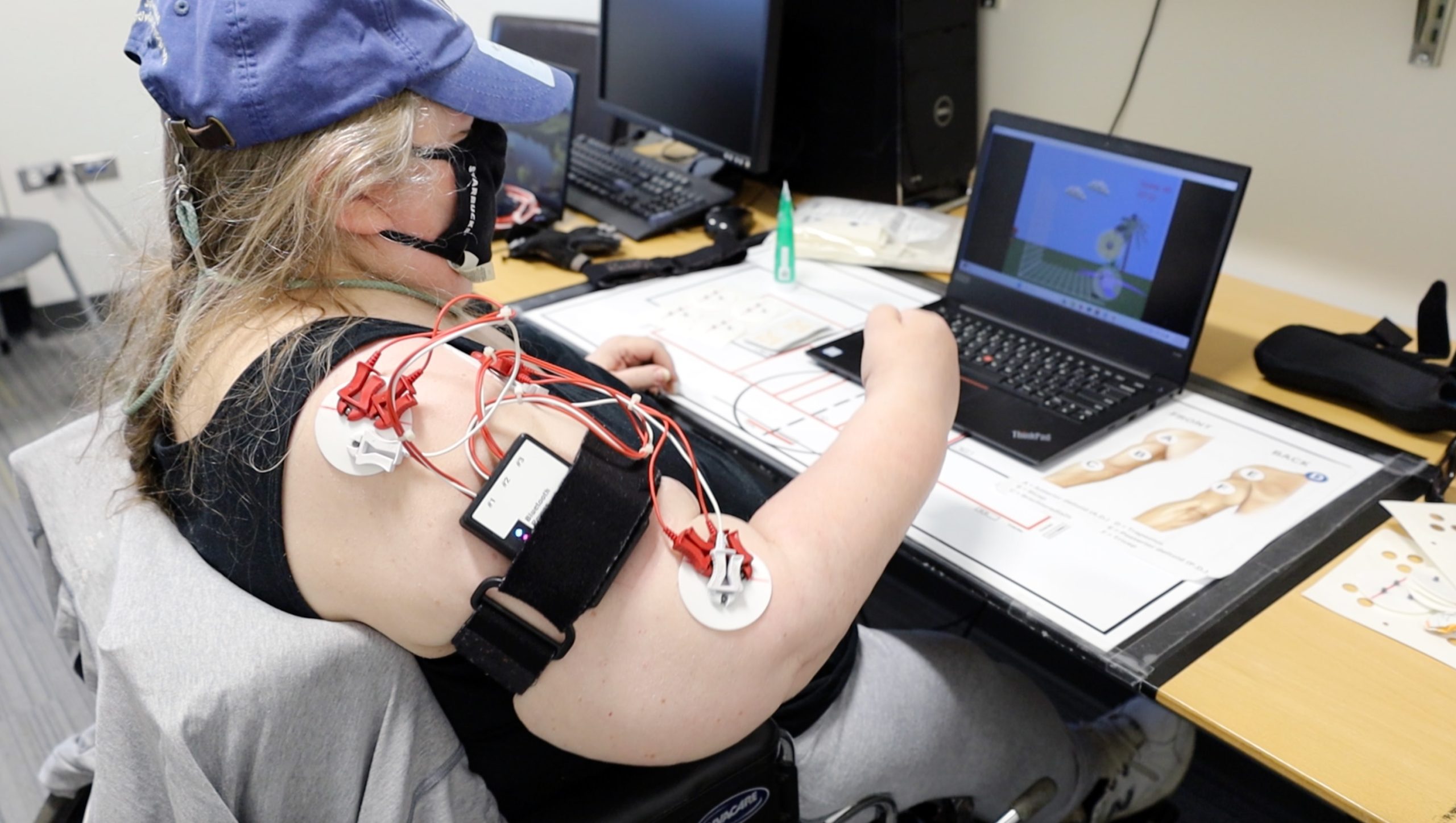
A customized throwback video game may offer a surprisingly futuristic path to stroke recovery. In a recent study, published in Neurorehabilitation and Neural Repair, Marc Slutzky, ‘02 MD, ‘00 PhD, ‘06 GME, professor of Neurology and of Neuroscience, and his team developed a 90s-style video game to help chronic stroke survivors regain lost arm function.
While wearing a small device on their impaired arm and using a laptop computer, players use their arm muscles to complete tasks such as flying a helicopter around the screen to hit a moving target. The muscle retraining helps separate the brain’s uncoordinated movement signals, enabling muscles to work independently again.
Patients in the study experienced moderate to severe arm impairment (only able to slightly move their arm and extend their elbow) from a stroke at least six months prior to beginning the study. The average patient was 6.4 years out from their stroke while some were 12 years out.
After six weeks of the game-based therapy, chronic stroke survivors improved arm function by 7.8 times as much as those in the control group. They also kept improving even after stopping the therapy.
Being able to play the game at home allowed for better access to the therapy and increased reps. Participants performed more than 300 reps per day compared to normal physical therapy in a clinic where they might get only 30 reps three days per week, said Slutzky, who was senior author of the paper.
Most stroke rehab today focuses on helping the stroke survivors by having them perform daily tasks, which often leads to survivors compensating for their impaired arm function. For example, leaning forward with the whole body to reach for an object rather than reaching for it with just the arm. While this technique is useful, it doesn’t directly aim to improve the movement of the arm. This study, however, found that the therapy improved the range of motion in the participant’s arm during reaching tasks, as well as their ability to perform daily activities.
“Here we’re doing something different,” Slutzky said. “We’re treating the impairment directly and measuring how much the actual arm improved in addition to performing certain functions. We found our conditioning really caused their improvement.”
The team, along with Northwestern bioelectronics pioneer John A. Rogers, PhD, the Louis Simpson and Kimberly Querrey Professor of Materials Science and Engineering, Biomedical Engineering and Neurological Surgery, is working to make the game’s wearable device completely wireless. They’re also upgrading the games to be more engaging, and in the future, they plan to test it on stroke survivors’ legs.
Addressing stroke treatment and recovery is vital to improving quality of life and health outcomes for many patients. These two studies offer novel ways Northwestern investigators continue to move the science forward.
Kristin Samuelson contributed to this story.